• A STORY OF MIDLIFE TRIUMPH! ONLY $4.99 ON KINDLE

  • Recent Posts

  • Categories

  • Review of Lean In by Sheryl Sandberg

    Lean In: Women, Work, and the Will to LeadLean In: Women, Work, and the Will to Lead by Sheryl Sandberg
    My rating: 5 of 5 stars

    As I read Lean In, I was intrigued at being able to get inside the head of a dynamic, smart woman who is one generation younger than me, and see the corporate world through her eyes. One of the cultural questions she answered for me was this: why are younger women so averse to the terms "feminist" and "feminism"? Apparently, Sheryl Sanders and her contemporaries believe(d) the following:

    1. Equality having arrived, there's no need for feminism anymore
    2. Feminists are man-haters who resist makeup and the shaving of one's legs

    Okay, #2 was a bit tongue-in-cheek. However, having observed conditions in the real world for a few years now, Sanders has come to see that the playing field is not and will not be level until more women occupy positions of power in the corporate hierarchy. She doesn't suggest that this is due to any malicious intent on the part of men, but rather it's simply a matter of ignorance.

    To illustrate, she describes having to park far away from her office door when hugely and uncomfortably pregnant. When she designated preferred parking spots to accommodate pregnant workers, no one complained. It was seen as logical. But prior to her taking her place in the C-suite, the issue hadn't been raised.

    Sanders talks about not slowing down out of consideration for what might happen in the nebulous future. The example she gives, now famous, is of a young woman confiding her fears of not wanting to accept a job with a lot of responsibility due to the impact it might have on her family. The woman was planning ahead - she didn't even have a boyfriend yet.

    With this example, Sanders makes the point that women, having been highly trained and educated, are waving off promotional opportunities. The jury is still out as to why, but she suggests, and I agree, that part of the reason is this: in corporate America, a woman's decision to go through pregnancy, childbirth, lactation, and child-rearing is viewed as a private matter that should not impact her ability to work long hours and irregular schedules, including lengthy and frequent travel as needed. Rightly fearing this may drive her insane, a woman who wants a family may leap off the corporate ladder at a very early stage.

    Sanders argues that if a young woman stayed on it long enough to secure a more powerful position, she would be able to exert more control over her work life (a perspective the young woman must trust will happen, since at her current low place on the corporate ladder she can only see her lack of power and control.) After a few promotions, she will be able to delegate some of her work to subordinates, afford more help at home, and influence workplace policies that unfairly impact women and families. Who can find fault with this argument?

    Sanders is honest about her own mistakes, and I found that charming. For example, I was amazed that, for all her intelligence and education, she didn't originally intend to negotiate her starting salary with Facebook. Luckily a nice man (her husband) set her straight, and she made a counter offer to Zuckerberg. Reams of guidance have been written about how this error could have impeded her in later years, both at Facebook and with future employers, yet she didn't know. For other women who have not yet made this horrifying discovery, please read Ask for It by Babcock and Laschever (http://www.amazon.com/Ask-Women-Power...) which in addition to being enlightening and entertaining, offers tons of strategies for preparing yourself to negotiate. And not just for salaries. After reading that book I saved $150 on furniture I was going to buy anyway, by asking one question.

    But back to Lean In.

    I was also surprised that she wasn't well informed about how women can sabotage other women in the workplace, particularly women in power. This is an unfortunate truth with roots in biology, and is brilliantly explained in the amazing book, In the Company of Women by Heim and Murphy (http://www.amazon.com/Company-Women-I...) which I reviewed here:
    http://www.goodreads.com/review/show/... This also suggests the reasons Sanders was hit with such a backlash for the well-intentioned Lean In.

    There is so much more to say about Lean In, but let me close with this: I enjoyed learning how this stellar corporate executive struggled, made mistakes, and ultimately learned some strategies that will enable her, her family, and the women (and men) in her corporation to thrive. It's not perfect, and sometimes it's not even pretty, but part of the lesson is to let go of the need for perfection.

    The other message, younger women, is to get as far and as fast as you can before starting your families. Don't opt out just because it looks too hard from where you're sitting now. The view improves with each rung on the ladder.

    View all my reviews

Are We Allowed to Slow Down in Retirement?

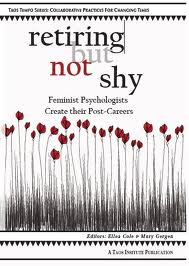
Retiring but Not Shy

Several years ago, a friend and I were talking about what we would do after we “retired.” I wanted to start a new career writing, teaching part-time, doing public speaking gigs, and blogging. She wanted to start a preschool! After decades at our corporate jobs, this was how we viewed retirement.

I was reminded of our conversation as I read the excellent book Retiring but not Shy, by Ellen Cole and Mary Gergen. The book is a collection of essays by women psychologists on the subject of their own retirement. Although some essays were by women who retired a while back, the ones I found most troubling were by those who were either considering retirement or had recently retired.

Like my friend and I, these bright, well-educated women had laundry lists of all the incredible new tasks and initiatives they would undertake. Retirement meant converting from busy/busy to busy/busy. Beyond financial security, many seemed afraid that giving up their jobs meant they would no longer “matter.” These stellar professionals, some of minority ethnicity, feared being marginalized by society after retirement.

Especially for us feminists, it’s hard to imagine walking away from the battlefield. We struggled against the social tide for those degrees, titles, professions and salaries. The achievement of professional stature became our our identity, our source of power, our protective shield.

When I gave up my profession, I didn’t feel special anymore, and looking back, this was where my post-retirement life got interesting. I found myself tackling some heavy questions.

  • Did I have value to society without my work? Does anybody?
  • Did I fear a judgment I’d attached to others who didn’t work? (As a society, this question has implications with elders as well as stay-at-home parents.)
  • Would I ever have the confidence not to work? To give up positional power? To still see myself as special, even without the hard-won mantle of office?

Ultimately, the greatest triumph of my sixth decade was gaining a sense of self-worth exclusive of my profession. To value myself without the suit and heels meant I had to view the rest of society in a more forgiving way. to look beyond the uniform and titles – or lack thereof.

In the book, one of the writers asks: if work equates to feminism and independence, to what does retirement equate?

I have come to see retirement as a time of enlightenment and the letting go of ego.

hamster on wheelOne writer says “I believe that even in retirement women must contribute to make a difference, to be perceived as powerful and to have power.” But powerful in whose estimation? We cannot make society respect us – we can only respect ourselves. And as for feminist battles, can’t we just model feminist principles as we putter in the yard, go to church, or help out down at the shelter? Why do we need to start a new national/international effort toward whatsis?

Will we ever accept that we are good enough?

Inspired to Change in Midlife

Whether you lost your job in midlife or feel the need to change/reinvent yourself for more benign reasons, it helps to see what other people our age are doing. In this article, a half-dozen older workers describe how they picked themselves up off the floor and created new work lives. I felt inspired by their stories. Maybe you will, too.

Joanne Hardy

Joanne Hardy

Sometimes success takes a while. Author Charlotte Rogan got her first book contract at the age of 57,  but she’s a baby. My friend Joanne Hardy is from the generation ahead of Charlotte’s, and Joanne just published her magnum opus, The Girl in the Butternut Dress.

I asked Joanne how she learned to write so well. She described persevering, and said:

imgres

The best class I ever took was Robert McKee’s three day seminar called “Story.” It is so dense and so thorough…I have taken it three times. He is just fantastic. When you go there you will see a block of seats reserved for well-known media groups, like Disney; they send their writers to him…I thought it well worth it. I came home and restructured my novel.

Not all of us are climbing career ladders. Some are struggling to figure out who and what we are at this stage, which can be intriguing in itself. My friend Ellen Cole created a blog, 70Candles, where women share their thoughts about aging mindfully. My own reinvention took the form of letting go of my corporate identity, and refusing to be judged for shedding my power suit. I decided I was good enough as a person, without the trappings of career to prove my worth to the world. One of my proudest accomplishments at this point in my life is providing day care for my grandbabies. It’s a big shift for a gal who never got to be a stay-at-home mom, but I think I’m at a point in my maturity where I can appreciate it better than if I were younger. Except for my aching back.

Yes, we’re getting older, but there are definitely some great benefits.

More Magazine surveyed 1200 women age sixty and up, asking them to rate their lives. What were they happy about? What did they regret? What have they learned about finding their true paths? Here are the high points:

  • The Betty White Boost: A distinct spike in confidence occurred at the uppermost end of the respondents’ age group. Quite simply, the older the women were, the more likely they were to give themselves high marks for life decisions. Women age 80-plus were the most likely to feel satisfied with their life choices. (Although More only surveyed women, this phenomenon has been documented in men, too.)
  • Know Your True Path: A majority of respondents said they found their true path in life after age forty.
  • Cool with Not Being Superwoman: a majority said having it all is a crock. Do what you can and pat yourself on the back, and that it’s okay to ask for help or to say NO.

I’m curious about you. Are you starting over in any way, with work or family or personal truths? If so, what did you change, and is it working? Are you feeling stronger or are you drifting? Do you have any bits of advice for us? I’d love for you to share your thoughts if you’re so inclined. (And now the baby is waking from his nap so I have to run!)

Morgan babies Xmas pic 2012

Hillary, When Do You Stop?

imgresI was going to write something funny today, but with the news about the blood clot in Hillary Clinton’s skull, I think this might be more important.

Many people speculate that Hillary Clinton is planning to run for president.  I don’t think so.

I think the fact that she’s letting her hair grow long is an announcement, conscious or otherwise, that she’s transitioning away from public service. She has plenty of power, plenty of interests. She could have an amazing retirement.

As Secretary of State, Hillary set records for global travel. At any age, that kind of schedule can take a toll on one’s body, not to mention the stress of her job. Now consider the health concerns of running for and perhaps taking on the job of president. Every one has aged visibly in office, disproportionate to the number of years in that role. Why should Hillary throw herself onto that pyre?

As a private citizen, Hillary would have the world at her feet. Reputed to have an IQ of 140, she probably knows she could serve on any board; learn, observe, participate in anything; travel anywhere. Any number of global titans would be happy, I’m sure, to lend her a jet and a vacation home. Wouldn’t you think?

“I am so looking forward to next year,” Hillary told Gail Collins recently. “I just want to sleep and exercise and travel for fun. And relax. It sounds so ordinary, but I haven’t done it for 20 years. I would like to see whether I can get untired. I work out and stuff, but I don’t do it enough and I don’t do it hard enough because I can’t expend that much energy on it.”

If she does return to civilian life, most of us would nod with understanding. Some things are more important than being Leader of the Free World. Like sleeping in, or turning off your phone for a couple days and catching up on the last few years’ worth of movies or books.

Some say that after menopause we’re more like who we were at age eleven. I think we long to return to who we were before all the obligations and transformations were required. Before we started changing ourselves into that nice young lady, that girlfriend, that worker, that wife, that mother, that corporate person. In the case of HRC, that global politician. Wouldn’t it be crazy to explore that path?

We yearn for authenticity. We miss the real us.

I’m reading a book about professional women transitioning into retirement. Many of their essays contain exhaustive lists of the equally high-level, professional accomplishments they expect to achieve in this new phase. It appears they expect to work part-time until they are prevented from doing so by death or disability. I understand remaining active and not turning into a sloth, but at what point will we feel we’ve earned the right to fritter away our time in joyful nothingness?

Perhaps we still feel a need to prove ourselves. Perhaps as older people we’re afraid of being marginalized, so we work hard to earn our keep and deflect criticism.

Yet, getting a blood clot in your skull can force you to reprioritize. You see that it might be okay to simply park your ass in a lawn chair and savor the quiet of mid-day on your own peaceful patio. Sure, it’s good to be productive. But here we are on this good Earth. What are we doing with that privilege?

Hillary is powerful, well-traveled, and accomplished. She’s a warm and loving person with a throw-her-head-back guffaw. I would award her Crone status. I admire the hell out of her, and I wish her the greatest happiness and hopefully, many years of dolce far niente.

  • Lynne Spreen

  • Follow LynneSpreen on Twitter
  • my read shelf:
    Lynne Spreen's book recommendations, liked quotes, book clubs, book trivia, book lists (read shelf)
  • Enter your email address to subscribe to this blog and receive notifications of new posts by email.

    Join 2,102 other followers

  • Review of Fierce with Age: Chasing God and Squirrels in Brooklyn

    Fierce with Age: Chasing God and Squirrels in BrooklynFierce with Age: Chasing God and Squirrels in Brooklyn by Carol Orsborn
    My rating: 5 of 5 stars

    When I saw the blog post, "Why You Should Treat Aging As A Mystical Journey"(http://www.mindbodygreen.com/0-8682/w...), I thought I might have found a kindred spirit in the author, Carol Orsborn. When I read this book, Fierce with Age: Chasing God and Squirrels in Brooklyn, I knew for sure. Carol Orsborn is on to something that I, at age 59, am really hungry for. I want to know how to feel valuable, powerful and at peace in the second half of my life, while still fully functioning in a society that demeans, caricatures, and negates older people.

    Carol, who is a good writer, describes a story arc that begins with everything falling apart. She is unwanted and then fired from her job in a world that worships youth. She tries to fight aging by staying in the ring with the younger people, but it gives her no real sense of security. She keeps coming up with ideas for holding back time, only to fail over and over again. Telling of her disappointments, Carol does a good job of layering the blows, one atop the other until we are reeling with her. When everything has been tried, every avenue exhausted, what the hell do we do next? Lie down and die? But we’re old, not dead! How do we navigate this new country?

    Nearly immobilized with discouragement, Carol struggles with the questions I’ve wrangled with: So now what, at this age? Who am I without the accouterments of my earlier life? My job, my youth, my expertise in a particular field? If I’m not running the race, do I even have value?

    One night, in the middle of a furious electrical storm, she stands on her balcony, screaming and shaking her fist at God, daring Him to kill her now.

    And He tells her to get over herself.

    From this point, Carol begins to glimpse another, more powerful reality. A gigantic paradigm shift later, the unfurling of which she describes in the second half of the book, Carol is once again back on top, no longer burdened by but rather fierce with age. And we’re fierce right along with her.

    Carol is very skillful in using metaphor to describe her journey. Particularly satisfying is her change of heart regarding the story of Moses, wherein she finally understands that God was saying, “It's okay to get old. I love you just as you are. So should you.”

    The only problem I had with the book was the spiritual, God aspect. It’s not like Carol misled me. God is in the title. Since I am not a believer, however, some points left me a bit frustrated until I got a brainstorm and began replacing the term "conscious growth" with God, and it worked fine! Here's an example:

    Carol: To stop "doing" my personality and leave space for God requires...

    Lynne: To stop "doing" my personality and leave space for conscious growth requires...

    At some point on our nation's timeline, I believe people our age will stop trying to be young and start seeking and finding the intrinsic value of age. It takes courage, though, because so much of it is beyond our control. Carol makes the point that we have to develop the ability to be at peace with that, and with the strength of maturity, we ought to be able to.

    The reward is freedom to become our true selves, unbound by the constraints of society as currently drawn. As Carol says, "The one thing that is up to you is whether you will make getting old a tragedy, or embark upon it as another of life's great adventures."

    View all my reviews

  • Blogs I Follow

    1. Lead.Learn.Live.
    2. Not quite at my wits' end...yet
    3. Waiting for the Karma Truck
    4. Deborah Batterman
    5. bobsbooksblog
    6. Guerrilla Aging
    7. krpooler.com
    8. Rock the Silver
    9. The Woman Doctor's Guide
    10. Life in the Boomer Lane
  • This Blog Got Five Stars!

Lead.Learn.Live.

David Kanigan: Inspiration, Ideas & Information

Waiting for the Karma Truck

Thoughts on work and life and everything in between

Deborah Batterman

there is a crack in everything . . . that's how the light gets in – Leonard Cohen

bobsbooksblog

A place of Elegant Review

Guerrilla Aging

Navigating the Third Half of Life

Rock the Silver

MIDLIFE MAGIC

The Woman Doctor's Guide

A guide to good health, women's wellness and getting it all done

Life in the Boomer Lane

Musings of a former hula hoop champion

Follow

Get every new post delivered to your Inbox.

Join 2,102 other followers

%d bloggers like this: